The Future of Real Estate Agency Software: CRM, CMS, and Marketing in One Dashboard
Updated: 12 December 2025
Khalid Nouri
4 min read
The Future of Real Estate Agency Software: CRM, CMS, and Marketing in One Dashboard
Why Traditional Real Estate Software Is No Longer Enough
The real estate industry has always relied on human relationships, negotiation skills, and local market knowledge. For decades, technology played only a supporting role, helping agencies store contacts, publish listings, and manage basic communication. That era is over. Real estate has entered a phase where software is no longer optional infrastructure — it is a strategic asset that directly influences growth, efficiency, and brand perception.
Despite this shift, a large number of agencies are still operating with tools that were designed for a very different market. They use generic CRMs built for any business, websites maintained by external developers, and marketing platforms that operate in isolation. While each tool may work reasonably well on its own, together they create friction, delays, and blind spots that limit an agency’s ability to compete.
The Legacy Stack That Still Dominates Real Estate
In many agencies, the technology stack has grown organically rather than strategically. A CRM was added to manage contacts. A website was built years ago and updated occasionally. Marketing tools were introduced later to support advertising and email campaigns. Over time, these systems became deeply disconnected.
This legacy approach introduces constant inefficiencies:
- Lead information moves manually between systems
- Property updates must be duplicated across platforms
- Agents rely on personal workflows instead of shared processes
- Managers lack a centralized view of performance
The result is a business that depends heavily on individual effort rather than structured systems. Growth becomes harder, onboarding new agents takes longer, and consistency across the agency is difficult to maintain.
Changing Client Expectations in a Digital-First Market
Modern buyers and sellers are highly informed before they ever contact an agency. They compare listings across platforms, analyze presentation quality, evaluate responsiveness, and form opinions based on digital experience alone. In many cases, the website and online communication define the agency’s credibility more than its physical office.
This shift has major implications. A slow website update, inconsistent property information, or delayed response can cost an agency a deal before a conversation even begins. Clients no longer separate marketing, content, and service — they experience them as one continuous journey.
Traditional software does not support this reality. When the website, CRM, and marketing tools are disconnected, agencies struggle to deliver a smooth and professional experience. What the client sees online does not always reflect what the agency is doing internally.
When Software Fails to Reflect How Agencies Actually Work
Real estate operations are inherently interconnected. A single property can generate dozens of leads. Each lead may follow a different path depending on budget, timing, and intent. Agents collaborate, hand off clients, and manage multiple negotiations simultaneously. Marketing activity influences lead quality, which directly affects agent performance.
Generic tools flatten this complexity. CRMs treat leads as static contacts. CMS platforms focus on content without understanding transactions. Marketing tools optimize clicks without linking them to closed deals. None of these systems are aware of the full lifecycle of a real estate transaction.
This disconnect forces agencies to rely on intuition rather than data. Decisions about pricing, marketing budgets, and agent allocation are made with partial information. Opportunities to optimize are missed because the tools cannot see the full picture.
The Operational Cost of Fragmentation
The true cost of fragmented software is rarely visible on a balance sheet. It appears in lost time, delayed follow-ups, and underutilized data. Agents spend hours updating records, switching between tools, and chasing information. Managers compile reports manually instead of acting on real-time insights. Marketing teams struggle to prove the impact of their work.
As agencies grow, these problems intensify. More listings mean more duplication. More agents mean more inconsistency. More leads mean higher risk of errors and missed opportunities. At a certain scale, fragmented systems become a structural bottleneck.
What makes this especially dangerous is that many agencies attribute these issues to market conditions or human performance, rather than to the limitations of their software. In reality, the system itself is preventing them from operating at full potential.
Why Incremental Fixes Are No Longer Enough
For years, agencies attempted to solve these problems by adding integrations, plugins, or additional tools. A connector between the website and CRM. A marketing automation add-on. A reporting dashboard layered on top of existing systems. While these solutions may offer short-term relief, they rarely address the root cause.
The problem is not a missing feature. It is a missing structure.
As long as CRM, CMS, and marketing remain separate systems, agencies will continue to experience friction. Data will lag behind reality. Teams will work around the software instead of with it. Complexity will increase faster than control.
The Shift Toward Unified, Agency-First Platforms
A new generation of real estate software is emerging in response to these challenges. These platforms are designed with the agency at the center, not as an afterthought. They recognize that website content, client relationships, marketing performance, and transactions are all part of the same system.
Instead of connecting separate tools, unified platforms are built as a single environment where:
- Leads are captured, enriched, and tracked automatically
- Properties function as both content and sales assets
- Marketing activity is directly linked to real outcomes
- Performance is visible in real time across teams
This approach reduces complexity rather than adding to it. It creates clarity where there was fragmentation and alignment where there was chaos.
Redefining the Role of Software in Real Estate Agencies
The most important change is not technological, but conceptual. Software is no longer just a tool used by agents and managers. It becomes the operational framework that defines how the agency functions.
In this model, best practices are embedded into the system. Data flows naturally between teams. Decisions are supported by live insights rather than delayed reports. Growth is supported by structure instead of manual effort.
Agencies that adopt this mindset early position themselves to scale efficiently, adapt quickly, and deliver a consistently high-quality experience across every touchpoint. Those that continue to rely on outdated, fragmented systems will find themselves constrained not by market demand, but by their own infrastructure.
How CRM and CMS Are Evolving for Modern Real Estate Agencies
As real estate agencies outgrow traditional software, the evolution of CRM and CMS systems becomes inevitable. What is changing is not only the interface or the feature list, but the very purpose of these tools. In modern agencies, CRM and CMS are no longer separate layers of the business. They are becoming two sides of the same operational system, designed to work together in real time.
This evolution is driven by a simple reality: in real estate, content, relationships, and transactions are inseparable. A property listing is content, but it is also a commercial asset. A website visitor is anonymous traffic, but also a potential client. A CRM record is not just a contact, but a relationship that evolves through multiple interactions. Legacy systems were never designed to handle this interconnected lifecycle.
From Contact Databases to Relationship Intelligence
Traditional CRMs were built to store information. Names, phone numbers, email addresses, and basic notes. While this may be sufficient for simple sales processes, it falls short in real estate, where timing, intent, and context are critical.
Modern CRM systems for real estate agencies are shifting toward relationship intelligence. Instead of asking agents to manually update every detail, these systems automatically collect and organize information based on real behavior:
- Website visits linked to specific properties
- Inquiries connected to campaigns and sources
- Conversations, viewings, and follow-ups tracked in one timeline
- Deal stages tied directly to listings and agents
This creates a living profile for each client, where context is preserved and history is always available. Agents no longer work from memory or fragmented notes; they work from structured insight.
CRM Built Around Properties and Deals, Not Just Leads
One of the biggest flaws of generic CRMs is that they treat every lead the same. In real estate, this approach is fundamentally broken. A buyer looking for a rental, an investor evaluating multiple assets, and a seller considering a valuation all require different workflows.
Modern real estate CRMs are being rebuilt around properties and deals, not just contacts. This means:
- Leads are associated with specific listings or projects
- Deals move through clear stages, from inquiry to closing
- Agents collaborate around shared opportunities
- Performance is measured based on actual outcomes
By aligning CRM structure with how agencies actually operate, these platforms reduce friction and improve clarity at every level of the organization.
The CMS Is No Longer Just a Publishing Tool
At the same time, the role of the CMS is undergoing a major transformation. Traditionally, a CMS was used to publish pages, upload images, and manage basic content. In many agencies, it was controlled by developers or external providers, making updates slow and expensive.
Modern CMS platforms are designed for business users, not just technical teams. They allow agencies to:
- Launch new listings instantly
- Update project pages without external help
- Customize layouts while preserving performance and SEO
- Keep content synchronized with CRM data
Most importantly, the CMS becomes directly connected to the agency’s operational data. When a property status changes, the website reflects it immediately. When a campaign launches, the relevant pages are already optimized for conversion.
When CRM and CMS Work as One System
The real breakthrough happens when CRM and CMS are no longer treated as separate tools. In unified platforms, they share the same data layer and logic.
This creates powerful capabilities:
- Website forms automatically create enriched CRM records
- Property pages adapt based on availability and demand
- Content performance informs sales strategy
- Agents see exactly how clients interact with listings online
Instead of guessing which properties attract serious interest, agencies can see it directly. Instead of updating content blindly, they can optimize based on real engagement data.
Empowering Agencies Without Increasing Complexity
One of the core goals of this evolution is to empower agencies without overwhelming them. Modern platforms hide complexity behind clean interfaces and intelligent defaults. Best practices are built in, not added later.
Agencies gain control over their digital presence without needing technical expertise. Agents focus on relationships instead of administration. Managers gain visibility without micromanaging.
This shift reduces dependency on external vendors and developers. The agency becomes more agile, capable of responding to market changes in days instead of weeks.
Scalability as a Built-In Feature
As agencies grow, their software must scale with them. Modern CRM and CMS platforms are designed to support:
- Multiple teams and branches
- Role-based access and permissions
- Custom workflows per agency model
- Expansion without replatforming
Scalability is no longer an upgrade or an enterprise-only feature. It is a foundational requirement.
The End of Generic Solutions
The evolution of CRM and CMS in real estate marks the end of generic, one-size-fits-all software. Agencies are demanding systems that understand their workflows, language, and business logic.
This shift is not about adding more features. It is about aligning software with reality. When CRM and CMS are designed specifically for real estate and unified in one dashboard, agencies gain clarity, speed, and control.
The next section will explore how marketing, analytics, and AI complete this ecosystem, transforming data into action and strategy.
Marketing, Analytics, and AI Inside a Single Real Estate Dashboard
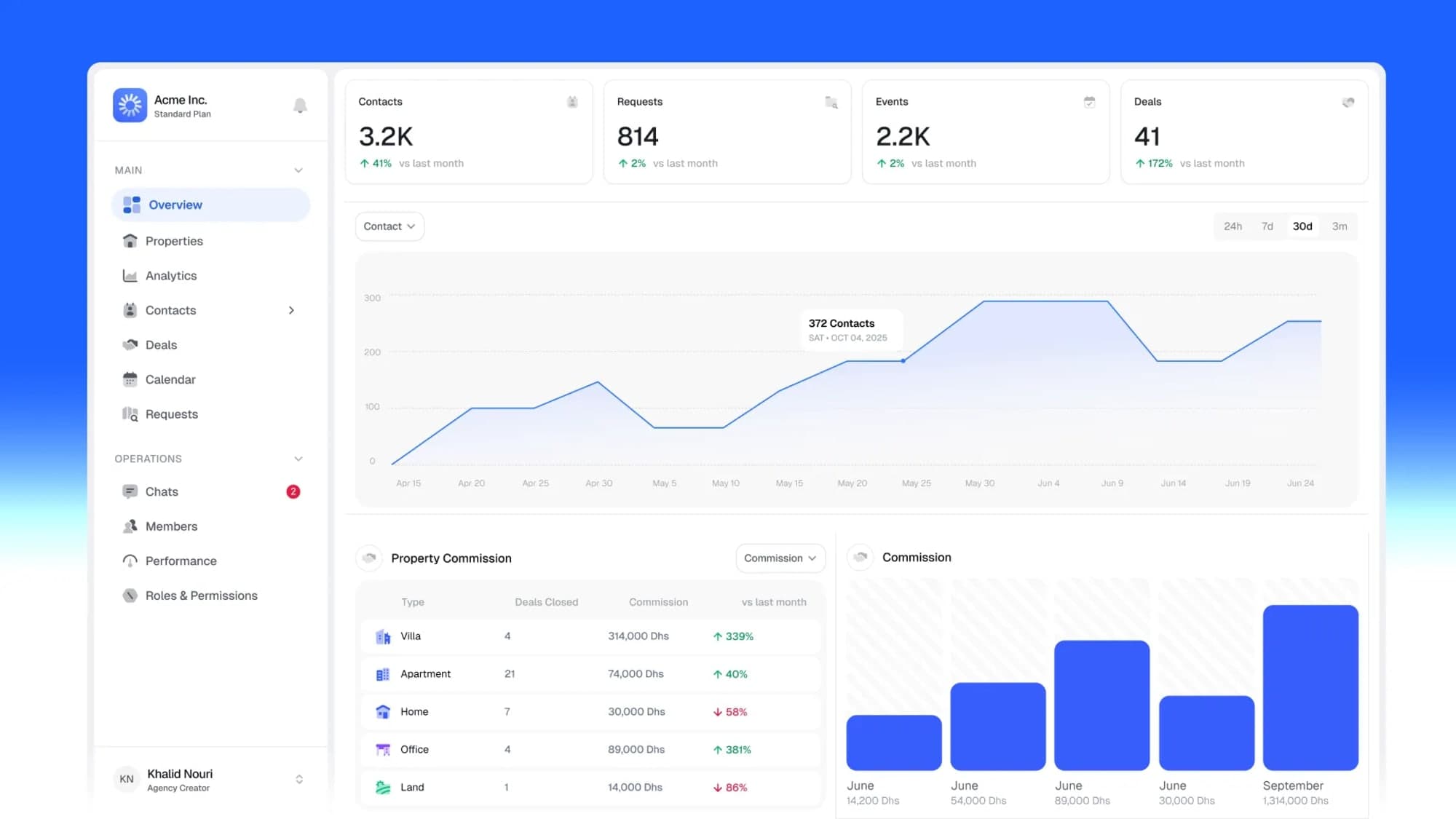
As CRM and CMS systems evolve to reflect the true structure of real estate agencies, marketing and analytics can no longer exist as isolated layers. In traditional setups, marketing lives outside the core system: campaigns are launched on external platforms, performance is measured in clicks and impressions, and results are reviewed independently from sales outcomes. This separation creates a dangerous gap between effort and impact.
In modern real estate agencies, marketing is not a standalone activity. It is a continuous engine that feeds the CRM, shapes the CMS, and directly influences revenue. The future lies in platforms where marketing, analytics, and AI operate inside the same dashboard as properties, clients, and deals.
From Campaign Metrics to Business Impact
Legacy marketing tools focus on surface-level indicators. Impressions, reach, click-through rates, and form submissions. While these metrics are useful, they rarely answer the most important questions for an agency: which campaigns generate qualified leads, which listings convert into deals, and which agents benefit from marketing investment.
Unified dashboards change this perspective entirely. Marketing activity is directly connected to operational data. A campaign is no longer measured by clicks alone, but by its contribution to real transactions.
This allows agencies to:
- Track lead sources at the property and campaign level
- Measure conversion from inquiry to visit to closing
- Compare performance across locations, projects, and price ranges
- Allocate budgets based on real return, not assumptions
Marketing becomes accountable, measurable, and aligned with business goals.
Real-Time Analytics as a Management Tool
Analytics is often treated as a reporting function, reviewed weekly or monthly through exported dashboards. In fast-moving markets, this delay is costly. Decisions based on outdated data lead to missed opportunities and inefficient resource allocation.
In unified platforms, analytics is embedded into daily operations. Managers can see, in real time:
- Which properties are generating the most interest
- Where leads are dropping off in the funnel
- Which agents are responding fastest and closing more deals
- How website performance affects lead quality
This visibility transforms analytics from a retrospective tool into a decision-making engine. Adjustments can be made immediately, not after results have already declined.
The Role of AI as an Operational Assistant
Artificial intelligence is often presented as a disruptive force, but in real estate platforms, its true value lies in subtle, practical support. AI does not replace agents or managers; it enhances their ability to focus on what matters most.
Inside unified dashboards, AI can:
- Prioritize leads based on intent and behavior
- Detect patterns in buyer and seller activity
- Suggest follow-ups and optimal timing
- Identify underperforming listings or agents early
These capabilities reduce cognitive load and help teams act proactively rather than reactively. The system becomes an assistant that highlights what needs attention, instead of a passive database waiting for input.
Turning Data Into Strategic Advantage
When CRM, CMS, marketing, and analytics are unified, data gains a new level of value. Information is no longer fragmented or delayed. It becomes a strategic asset that informs every level of the organization.
Agencies can identify trends across their entire operation. They can see which types of properties perform best in different market conditions. They can adjust pricing, presentation, and promotion based on evidence rather than intuition. Over time, this creates a feedback loop where each decision improves the next.
This level of insight is impossible when systems are disconnected. Unified platforms create a shared language between marketing teams, agents, and leadership.
Brand Consistency and Control Across All Channels
Marketing is not only about performance; it is also about perception. Unified dashboards give agencies full control over how their brand is presented across all touchpoints.
Website content, property pages, and campaigns are managed from the same system, ensuring consistency in messaging, visuals, and tone. Updates are reflected instantly across channels, reducing errors and misalignment.
This consistency builds trust. Clients experience the agency as professional, organized, and responsive. Over time, this perception becomes a competitive advantage.
Scaling Marketing Without Scaling Chaos
As agencies grow, marketing complexity increases. More listings, more channels, more campaigns, more data. Without structure, growth leads to chaos.
Unified platforms are designed to scale. They support multiple teams, campaigns, and markets while maintaining clarity. Automation handles repetitive tasks. AI assists with prioritization. Analytics provides oversight.
This allows agencies to grow their marketing efforts without losing control or increasing operational burden.
Completing the All-in-One Vision
Marketing, analytics, and AI complete the transformation of real estate agency software. When combined with modern CRM and CMS systems, they form a single operational environment where every action is connected and measurable.
The future of real estate agencies is not defined by having more tools, but by having the right system. One dashboard. One data source. One clear view of the business.
Agencies that adopt this model gain speed, insight, and confidence. They move from reacting to market changes to shaping them, supported by software that finally matches the complexity and ambition of their work.
Traditional Real Estate Software vs Unified All-in-One Dashboard
| Aspect | Traditional Setup | All-in-One Real Estate Dashboard |
|---|---|---|
| Core Tools | Separate CRM, CMS, marketing tools | CRM, CMS, and marketing unified |
| Data Flow | Manual syncing and duplication | Real-time shared data |
| Website Management | Developer-dependent updates | Instant in-house editing |
| Lead Tracking | Basic contact storage | Full journey from visit to deal |
| Marketing Insights | Clicks and impressions only | ROI tied to properties and deals |
| Agent Performance | Hard to measure accurately | Real-time performance visibility |
| Scalability | Becomes complex as agency grows | Built to scale with teams |
| Decision Making | Delayed, incomplete reports | Live, data-driven insights |
| Brand Control | Limited and fragmented | Full control under one system |
What This Means for the Future of Real Estate Agencies
The convergence of CRM, CMS, and marketing into a single dashboard represents a fundamental shift in how real estate agencies operate. Software is no longer just a support layer used to store data or publish listings. It becomes the operational backbone that defines workflows, enforces consistency, and enables growth.
Agencies that adopt unified platforms gain clarity across their entire business. Every listing, lead, campaign, and deal exists within the same ecosystem. Teams collaborate more effectively because they work from a shared source of truth. Managers move from reactive reporting to proactive decision-making. Marketing becomes measurable, strategic, and directly tied to revenue.
At the same time, agencies regain control over their brand and digital presence. Websites are no longer static or outsourced assets. They evolve continuously alongside market conditions, campaigns, and inventory. The agency becomes faster, more adaptable, and more resilient.
The Direction the Industry Is Moving Toward
The future of real estate agency software is not about adding more features or tools. It is about removing fragmentation and replacing it with structure. Platforms that are designed specifically for real estate agencies, and that unify operations under one dashboard, will define the next generation of the industry.
Agencies that embrace this shift early will be able to scale without chaos, compete on experience rather than price, and build long-term trust with clients. Those that continue to rely on disconnected systems will increasingly struggle to keep pace in a market that rewards speed, insight, and professionalism.
The future belongs to agencies that operate with clarity, powered by software that finally understands how real estate really works.